
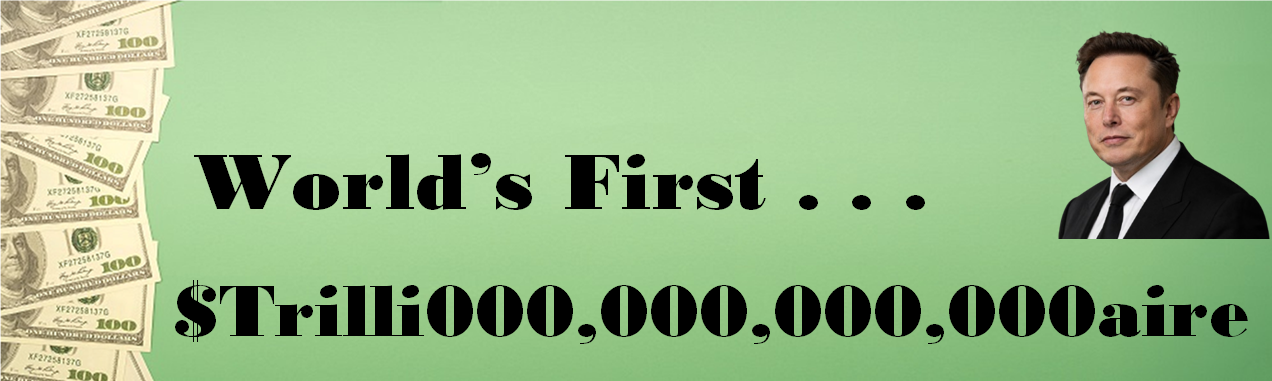
Elon Musk . . .
. . . World's First Trillionaire
But the Real Story Is the Quarter-Century Before Him
On June 12, 2026, SpaceX began trading on the Nasdaq and pushed Elon Musk past a number nobody in human history had ever reached. A trillion dollars. A one - followed by twelve zeros.
1 Minute Video
I'm not here to write about Elon Musk
I went back through the Forbes list of the world's richest people — year by year, from 2000 to today — and followed where the money came from. What jumps out isn't one man. It's the staircase. The price of being rich has been climbing the entire time… and *the kind of wealth* that gets you to the top has quietly flipped. That's the part worth understanding, because it tells you where value actually comes from now.
The Price of Admission Keeps Going Up
Here's the simplest way to see it. Forget 1st place. Look at 10th slot of the Top 10 — the very last seat at the table. That's the floor. That's what it cost just to *make* the top ten in any given year.
- In 2000, about $16 billion got you in.
- By 2010, around $24 billion.
- By 2018, about $59 billion.
- By 2024, about $114 billion.
- By 2026, about $148 billion.
Read that again. At the start of the century, sixteen billion bought you a seat. A quarter-century later, the *cheapest* chair in the room cost nearly ten times that — and every single person in the top ten was worth more than $100 billion. The floor didn't just rise… the whole building got taller.
Did your paycheck magically 10x since 2020?
The Map Keeps Getting Redrawn
Now look at *where* the money came from — because this is the real shift.
In 2000, at the height of the dot-com boom, the top of the list was a wall of technology names: Bill Gates, Larry Ellison, Paul Allen, Michael Dell. Software and computers ruled.
Then something interesting happened. By 2010, right after the financial crisis, the list was the most *diverse* it had ever been — Mexican telecom, Indian steel and energy, French luxury goods, Spanish retail. Tech had thinned out. For one brief stretch, the world's largest fortunes came from all over the map and all kinds of industries.
That moment didn't last. By 2018 the list was snapping back, harder than ever, toward American technology — and by 2026, eight of the ten richest people on Earth had built their fortunes in tech. For the first time, the founder of the chipmaker Nvidia joined them, lifted by the artificial-intelligence boom.
2018: The Year of the First Centibillionaire
I wrote a post back in 2018, when Jeff Bezos became the world's first centibillionaire — the first person ever worth more than $100 billion. At the time it felt like a ceiling. A once-in-a-generation number.
It was a starting gun.
Just six years later, in 2024, $100 billion wasn't the ceiling anymore — it was the *floor*. Everyone in the top ten had crossed it. The number that once defined the single richest person alive had become the mere price of admission.
What This Actually Means for You
The lesson isn't "go be a billionaire." The lesson is about *what kind of asset builds wealth in your era* — because it changes. In 2000 it was software. For a while it was oil, steel, and retail. Today it's ownership of the companies building the future, and right now that frontier is artificial intelligence.
Notice too that Musk's trillion didn't come from a paycheck. It came from *owning* a piece of something — SpaceX — that the market suddenly decided was worth a fortune. Nobody at the top of this list got there on salary. They got there on ownership. That's the quiet thread running through every year of it.
You don't need a billion to apply the principle. You need to ask the same question they did: "What do I own a piece of… and is it pointed at where value is being created next?"
The Reality Is…
The reality is that a trillionaire was always coming. The staircase has been climbing in plain sight for twenty-six years — we just weren't all looking at it. The headline today is one man's name. The story underneath is a quarter-century shift in where wealth lives… and a simple reminder that the people at the top of every one of these lists owned the future before it arrived.
A Roger Bannister Moment?
For decades, runners believed the four-minute mile was a physical impossibility. Then in 1954, Roger Bannister broke it — and within a year, others were breaking it too. The barrier turned out to be in the mind more than the legs.
So the real question isn't whether Elon Musk reached a trillion dollars. It's whether the trillion-dollar mark is a "Roger Bannister moment" — a wall that, once broken, gets broken again and again — or a one-off that won't be repeated in our lifetimes.
In Closing . . .
Consider the pace. Musk wasn't even among the ten richest people in the world in 2020. He broke into that list in 2021… and reached a trillion dollars just five years later. If that's the new speed, the next one may not take a quarter-century to arrive. It may already be on its way.
Either way — the smart move isn't to watch the record-setters. It's to notice what they're standing on… and to make sure you own a little of it yourself.